The reasonable person: a legal ideal, or a mirror that does not reflect everyone?
What the legal perspective on normality reveals — and what it sometimes leaves out
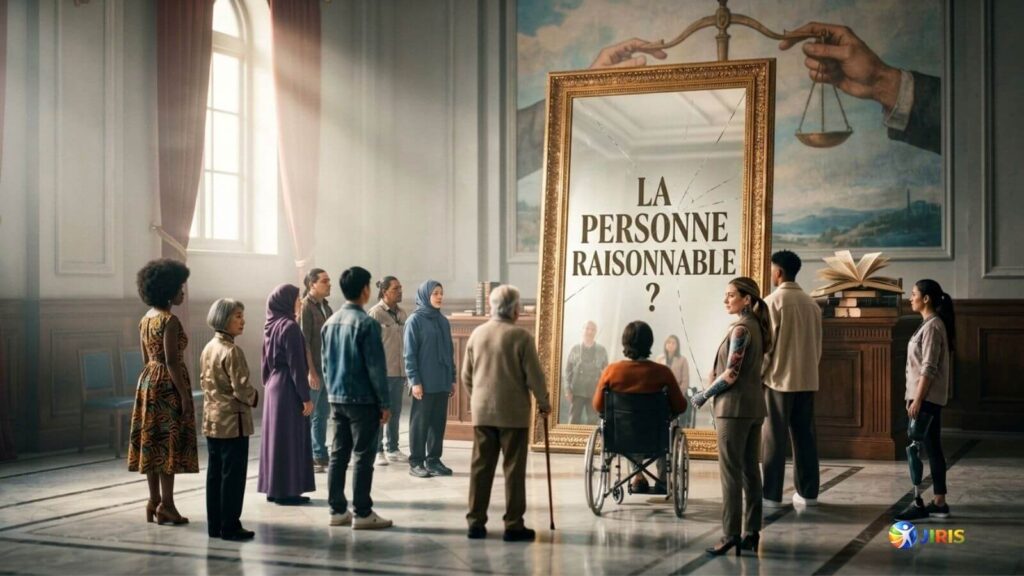
In a courtroom, a judge often faces an unspoken question: was this behavior what could have been expected? To answer it, the law invokes a figure that exists nowhere and yet is everywhere: the "reasonable person." What would a reasonable person have done, placed in the same circumstances? If the answer deviates too far from what actually happened, the behavior can be deemed wrongful, negligent, or sometimes even more serious.
This standard makes the law possible. Without it, each situation would have to be judged as absolutely unique, without any common reference points. But one question remains: who does this "reasonable person" really look like? Is it a neutral ideal, or rather the portrait—often unconscious—of what a society, at a given time, considers normal?
A standard that never fell from the sky
The law needs reference points. But these reference points are not objective data suspended above society: they bear its traces. The sociology of law has long reminded us of this—the normality that the law mobilizes is a dynamic, constructed notion that changes with the times and social relations.
The very history of civil law provides a concrete example. For decades, the standard used to judge prudent behavior was not the "reasonable person," but the "good family man"—a figure that was not neutral: it referred to a historically situated representation of the prudent and diligent person. This standard was eventually abandoned and replaced, in several French-speaking jurisdictions, by a more neutral formulation. This change in vocabulary is not a cosmetic detail: it shows that even the tools the law uses to define what is "reasonable" are themselves shaped by the representations of an era, and that they can evolve with it.
When the law addresses the abnormal
The law does not merely observe normality; it actively uses it to assign consequences. In matters of civil liability, the assessment of fault rests, in particular, on a comparison between the behavior adopted and that which could reasonably have been expected in the circumstances. The law thus seeks to determine whether conduct deviates from the applicable standard of behavior. A similar line of reasoning structures liability for things: courts examine whether a thing has exhibited behavior or a position that can be described as abnormal. The notion of abnormality has thus diversified to the point of becoming, according to some legal scholars, a genuine criterion for legal discrimination in the technical sense of the term—a tool that can give rise to an obligation to provide compensation.
This mechanism is not arbitrary: it allows for the resolution of disputes and the protection of injured parties. But it also serves as a reminder that, in order to function, the law must constantly draw a line between what is considered normal and what is not — and that this line is never completely independent of the social context in which it is drawn.
When a neutral rule produces an unequal effect
Sometimes a rule applies exactly the same way to everyone, yet it disproportionately penalizes certain individuals. Quebec law recognizes this mechanism as discrimination due to a prejudicial effect: a norm, rule, or practice that appears neutral and universal may, in fact, have a different impact on different people—and this impact can become discriminatory when it is unjustified.
Let's take a simple example. An organization requires all its members to complete a fixed number of tasks each month. A person with a disability, whose condition fluctuates, is sometimes unable to meet this requirement. The rule has never targeted this person specifically—it is, in fact, the same for everyone. But if its consistent application ultimately excludes them, this can constitute discrimination, even in the absence of any malicious intent. It is precisely to address this type of situation that the law provides for the obligation of reasonable accommodation: not a favor, but a means of enabling the effective exercise of a right despite the particular effects that a rule or practice may have on an individual.

The paradox of protection
There is an even deeper tension. In order to benefit from certain rights or accommodations, the situation experienced often needs to be recognized, named, sometimes labeled by a specific legal category: person with a disability, person involved in the justice system, person with a mental health disorder.
Sometimes the law creates these categories itself. Sometimes it borrows terms from medicine or psychology and gives them legal force. In both cases, the label becomes a necessary step to access certain rights.
But this categorization process has effects that extend beyond the rights it grants. Research in the sociology of law has shown how these criteria, over time, become veritable labels. These labels can open doors to rights—and that is their very purpose. But they can also, in certain situations, contribute to closing other doors through a less visible effect.
It's not always the label itself that's the problem. Sometimes it's the way it's used: the connotation it carries, how it's perceived by those around it, or the burden it can represent for the person receiving it. The same label can be experienced as recognition by one person and as a reduction by another, depending on the context, how it's presented, and what it evokes for the individual concerned. For one person, a diagnosis has been a key to understanding and access to appropriate care. For another, the same label has become a stigma, a filter through which those around them see only an "illness."
This paradox does not invalidate the protective role of the law. It does not call into question the need to categorize in order to protect. Rather, it invites us to look at what protection produces, and not just what it states in the texts: to examine how a label is used, perceived, and experienced—and to ensure that it does not erase, behind the benefit it provides, the person it designates.
The law that teaches us to look at the context
The law is not fixed. It evolves, sometimes slowly, as social relations themselves transform — contemporary sociology of law speaks of a two-way relationship: the law structures behaviors, while itself being shaped by them.
A Canadian example clearly illustrates this evolution: in R. v. Gladue, the Supreme Court of Canada recognized the importance of considering, when determining sentences, the specific circumstances affecting Indigenous people and the consequences of overrepresentation in prisons. This principle is particularly illuminating for our discussion: the same rule applied without regard to circumstances can produce profoundly different effects depending on the individuals involved.
This evolution does not mean that all differences should be accepted without limit. Certain rules protect fundamental interests—security, integrity, the rights of others—and nothing in this reflection seeks to dissolve them. Rather, it is about recognizing that a standard that is too rigid, applied without regard to context, can miss precisely what it purports to measure.
A more useful question than "Is this normal?"
Perhaps the question "Is this normal?" isn't always the most relevant when faced with a legal or social situation. Other questions can sometimes shed more light on the matter: Can this person actually exercise their rights under the conditions imposed upon them? Does the applicable rule take into account their specific situation, or only an abstract model of how things work? Is what appears to be a discrepancy truly a problem—or a sign that the framework itself is too narrow to accommodate the real diversity of life experiences?
These questions do not seek to abolish norms. They invite us to examine their rationale and concrete effects, rather than following them as if they were self-evident.
Neither relativism nor rigidity
Recognizing that the "reasonable person" is a social construct does not mean that everything becomes relative. Common rules remain necessary; limits remain legitimate. But confusing what is expected by law with what would be humanly "normal" can lead to judging too quickly those paths that do not fit the predetermined mold.
A person is not defined by their diagnosis. Behavior is not always a reflection of a clear intention. Difficulty functioning like the majority does not signify a refusal to adapt—it can also reveal that a framework was designed for only one type of individual.

A question to keep with you
The next time a behavior, a request, or a situation seems "abnormal" according to the law or ordinary rules, a question can help to clarify things: what exactly is this judgment based on? A requirement truly necessary for collective life, or the reflection of a model of person that may never have truly existed?
This question has no single answer. But it can open a space between the rule and the person — a space where the law remains a tool at the service of justice, rather than a verdict on what someone is.
JIRIS will assist you
The legal perspective on normality deserves to be examined with as much rigor as the social perspective. JIRIS sees it as a powerful lever for inclusion — provided that we recognize that it, too, carries the representations of the era that shaped it, and that it continues to evolve with them.
Our training programs invite organizations, stakeholders, and citizens to explore the connections between legal norms, social norms, and lived realities — so that a more just society does not simply ask people to fit into the framework, but also examines what that framework produces, and for whom.
At JIRIS, we believe that the best solutions emerge from shared reflection. That's why our training programs don't just aim to impart knowledge: they create a space to understand the issues, question practices, and build solutions tailored to each specific situation.